
Helping all children become happy learners
working Memory
Introduction
At its simplest, working memory can be described as our capacity to process 'things' in our head. These 'things' are the bits of information from our sensory sytems and the products of our thinking. There is a limit to the amount of 'things' we can hold on to at any one time and that is the limit of our working memory or capacity. Because we are continually bombarded by more 'things' than we can handle, working memory also involves decision making processes that select the most important 'things' for us to focus on and pay attention to. This means that our attention and concentration are directly linked with working memory.
What is the theory behind working memory?
There is no specific part of the brain that can be said to be where our working memory is. Rather it is a product of many different cognitive processes located throughout the brain. Neuroscientists are discovering many of the specialised areas of the brain like the hippocampus that are important for memory but essentially working memory remains a theoretical model. There are a number of models that try to explain how we think, process sensory information and remember. One of the most widely accepted models is that of Baddeley and Hitch who originally published their work in 1974 and much of the research into working memory is based on their theory.

Briefly, the Baddeley and Hitch Model suggest four separate components involved in working memory: the central executive, responsible for attention, decision making and thinking; phonological loop for sounds and language; visual sketchpad for shape, space and movement and episodic buffer for place in time and order. A weakness in one or more areas can lead to working memory difficulties. Equally, the profile of difficulties varies depending on which components are affected.
What is normal working memory development?
The capacity of our working memory changes throughout our lives. There is very little capacity at birth and this gradually increases during childhood to reach its maximum at about 14 years of age.

How does working memory capacity affect us?
Working memory uses short-term memory to store items to be remembered whilst the brain performs some thinking related to the items stored. As a result of thinking there are new items either created or retrieved from long term memory that now need to be stored in short-term memory and this can lead to other items being lost. A lot of the time this won't matter but sometimes we forget items that we still need and this leads to failure to complete a task. Research suggests that there are separate storage systems for verbal and visual items meaning that the capacity for each can be different. There is also a third capacity involving chronology, the order in which things happen, and this can help us remember sequence of the events such as in a story. Working memory can be equal to the individual's short-term memory but is usually less and can be a lot less.
Our working memory capacity is particularly limited by our short-term memory as this stores both the things we want to think about and the products of our thinking. For example, in order to multiply 7 x 8 we need to store three different bits of information before we make the calculation and then have the answer 56 to hold on as well. For those of us who have learnt our multiplication facts we will have got the answer from our long-term memory and this is relatively easy. For children who have not learnt these facts; they will have to do more thinking and need to store more bits in their memory e.g. counting up 8,16,24,32,40,48,56. As an adult we can experience what this is like by trying to multiply 4783 x 3879 in our heads. We will struggle because we can't keep track of all the numbers and results of calculations needed to find the answer. It is not a limit of mathematical ability (assuming that we could do it with pen and paper) rather it is a limitation of memory.

Advertisement
How do you measure working memory capacity?
Working memory is complicated by the fact there are different systems for visual and verbal items. Many tests measure verbal items and a simple and limited test (resource below) is to see and/or hear several numbers in a sequence and be able to recall this in reverse order a few seconds later. Other tests may measure how much visual information can be processed. Sometimes an aggregate score is given combining verbal and visual sub-tests. Confusion can arrive as different tests may measure different aspects of working memory and consequently give varying results for the same individual. Results should perhaps therefore always be considered indicative of the individual's capacity.
What is weak working memory?
Working memory capacity develops throughout childhood and reaches maximum at about 14 years of age. Like other human variables, such as height, individuals vary in their working memory capacity: some children will be taller or shorter than their peers whilst some children will have bigger or smaller working memory capacities. This means that some children will have normally developing working memory but it will be weaker than their peers making learning a lot harder for them.
Working memory requires a number of different thinking and storage processes all operating together. A problem with one or more of these processes can lead to weak working memory. Different processes are involved in remembering and processing different types of information so an individual can be weak in one area and normal or better in another area.
How do You recognise children with weak working memory?
When a child has weak working memory capacity compared to the average of their class then they are likely to experience difficulties with following instructions and understanding explanations leading to poor academic progress. Teachers often observe the following characteristics in their students learning behaviour:
They often fail to follow instructions
They make frequent errors in their working out
They often get the sequence of multi-step tasks in wrong order
They find writing tasks particularly difficult
They may often forget what they were going to say
Some have reading comprehension difficulties
Frequently lose their place in tasks
Will need more adult prompts than their peers
More easily distracted
Are some children more likely to have working memory difficulties?
There is strong evidence linking working memory difficulties with a number of common learning and behaviour conditions. This is not surprising giving the crucial role of working memory in learning, sensory processing and thinking processes. Research shows different working memory profiles of children with the following diagnoses:
ADHD (Attention Deficit Hyperactivity Disorder)
ASD (Autistic Spectrum)
Dyscalculia
Dyslexia
Resources
BehaviourS Associated with Weak Working Memory

A useful checklist of behaviours which can indicate weak working memory. Ideal resource to support pupil observations
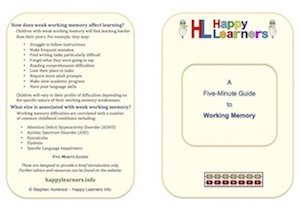
Five-Minute Guide to Working Memory
Short Term and Working Memory Digit Recall Tests
