Helping all children become happy learners
Memory
Introduction
Memory is our ability to store and later recall our experiences. It is essential to our survival as it enables us to adapt our current and future behaviour based on what we have learnt in the past. Learning can therefore be thought of as the process of laying down memories that may be useful in the future. There appears to be no limit to the amount of memories that can be permanently stored in the human brain but that doesn't mean that we remember everything. Nor would we want to! In fact, we only permanently store a very small amount of our daily memories. Most things are discarded as unimportant, particularly routine and familiar experiences. Even things we want to remember are often forgotten and this is explored below. There are a number of different specialist memory components suggested by researchers but, for the purpose of this article, we will limit ourselves to a description of memory in the short, medium and long term.
Understanding Memory
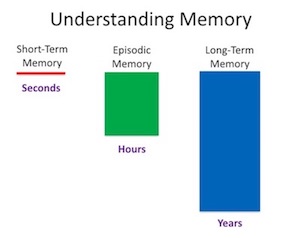
We have different memory capacities and abilities depending on how long we are trying to remember something. Some things we only need to remember for a few seconds whilst others we want to hold onto for a lifetime.
Short-term Memory
Short-term memory enables us to hold on to a wide range of sensory and thought products for a few seconds. For example, whilst reading this sentence you store individual words until you can make sense of its meaning. Once understood the words are forgotten.
Long-term Memory
Long term memory is our permanent store and enables us to remember things we learnt or did many years ago. It is believed that once committed to long term memory this is permanently fixed. Over time we may struggle to recall this memory but this may a problem in 'finding' and retrieving rather than a loss of the memory. However, the more we tend to recall a memory the more likely we can 'find' it again when we want it. The cliche 'If you don't use it, you lose it.' may have some truth with memory.
'Something in between' memory
Between short and long term memory is a medium memory generally known as episodic memory. This memory enables us to remember recent events: where we have been and what we have done. E.g. like what we ate for breakfast this morning. These memories fade over a number of days unless committed to long term memory.
Memory and Learning
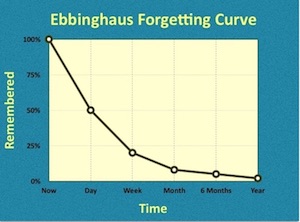
Each of these three memory systems is crucial for effective learning and it is perhaps surprising that initial teacher training does not focus more on understanding the mechanisms of memory. For schools, this lack of knowledge on how memory works leads to a loss in learning potential. Clearly, children do remember things and make good progress but greater awareness of memory could improve this further. In 1885 a German psychologist called Hermann Ebbinghaus formulated a theory of forgetting which attempted to describe how memories fade over time. He recognised how factors such as sleep and stress affected memory retention. He also proposed the concept of overlearning, repeatedly going back over the same learning to consolidate memory.

Advertisement